
Software / Web
Industry: Healthcare
20,000+
Hospital records managed
In short
Arcetis designed and built a premium public website and a custom Hospital Management System for Aastha Kidney & Specialized Hospital in Pokhara, Nepal. The reactive HMS — built on React, TanStack Start, and a self-hosted Convex backend with Better Auth — runs patient registration, appointments, visit history, and an automated follow-up engine built around the recurring dialysis schedules that define renal care, with role-based access enforced server-side and SMS reminders sent to patients and doctors. The hospital manages more than 20,000 records in one live system.
Aastha Kidney & Specialized Hospital is a specialist kidney and renal-care hospital in Pokhara, Nepal, established in 2018 — nephrology, dialysis, AV fistula surgery, and chronic kidney disease management, with round-the-clock emergency care. Renal care runs differently from general outpatient care: a dialysis patient does not visit once, they return on a recurring schedule, and the single most important operational question at any moment is who is due for their next session and follow-up, and whether the reminder actually reached them. The hospital was managing that — along with registration, appointments, and enquiries coming in from its website — largely by phone and on paper, with no shared record. Arcetis was engaged to build both halves of the solution: a credible, modern public website, and behind it a lightweight internal Hospital Management System designed around how a dialysis-led hospital actually operates.
A hospital management system fails in one of two ways: it is too thin to be useful, or so heavy that the staff quietly go back to their phones and notebooks. For a specialist kidney hospital, the design had to resolve that tension against a very specific clinical reality — recurring dialysis. Unlike a general clinic where most visits are one-off, renal care is built on patients who return on a schedule, so the system's core job is not simply "book an appointment" but "tell us, reliably, who is due and how urgent each one is, and prove the reminder was delivered." That reframing drove a deliberate "light" design principle, treated as a testable constraint rather than a slogan. Reception runs on low-spec desktops over ordinary broadband, so registering a walk-in patient had to be doable in seconds with a handful of fields, list screens had to stay fast and paginated rather than loading every patient at once, and no module the hospital had not asked for was allowed to add weight. Statuses, counts, and follow-up urgency are derived from a few stored facts rather than maintained by hand, so there are fewer states to fall out of sync. The reminders themselves were the part that had to be dependable, not decorative. A follow-up is only real if the message reaches the patient and the doctor, on time and without accidental duplicates — which meant an automated, scheduled messaging pipeline with delivery logging, not a best-effort notification. On top of that, a hospital has genuinely different roles — administration, doctors, reception, nursing — that must see different things, so access control had to be built into the foundation and enforced on the server for every action, never merely hidden in the interface. And because the public website needed to show the live doctor and department directory and accept appointment requests straight into the system, the two halves had to be joined by a small, stable API rather than kept as disconnected projects.
Arcetis led the end-to-end design and build of both the public website and the Hospital Management System, and deployed and operates the system on the hospital's infrastructure. The HMS is built on a modern TypeScript monorepo: a React and TanStack Start frontend with shadcn/ui and Tailwind, a self-hosted Convex reactive backend (queries, mutations, actions, HTTP actions, and scheduled cron jobs), and Better Auth for authentication. Arcetis built patient registration and profiles, visit history and clinical notes, internal appointment scheduling, an appointment-request queue fed directly from the public website, and ward and bed management across the hospital's General Ward, ICU, and Post-Operative units with live occupancy and an admit flow. Arcetis built the follow-up engine at the centre of the system — its configurable, colour-coded urgency status designed around recurring dialysis schedules — together with the automated SMS alert pipeline behind it: a provider-agnostic gateway adapter, message queue, scheduler, delivery logs, and duplicate prevention. Arcetis built the operational reports suite — new patients, appointments, no-shows, request conversion, follow-up completion, overdue follow-ups, and SMS delivery — with date ranges expressed in the Nepali Bikram Sambat calendar that hospital staff actually use. Arcetis implemented role-based permissions enforced server-side on every backend function, full audit and activity logging, and system settings, and exposed a small, stable public API so the website can read the doctor and department directory and submit appointment requests. Because Convex's queries are reactive, dashboards, ward occupancy, and follow-up lists update live without polling — which directly served the hospital's need for a system that never makes staff hit refresh.
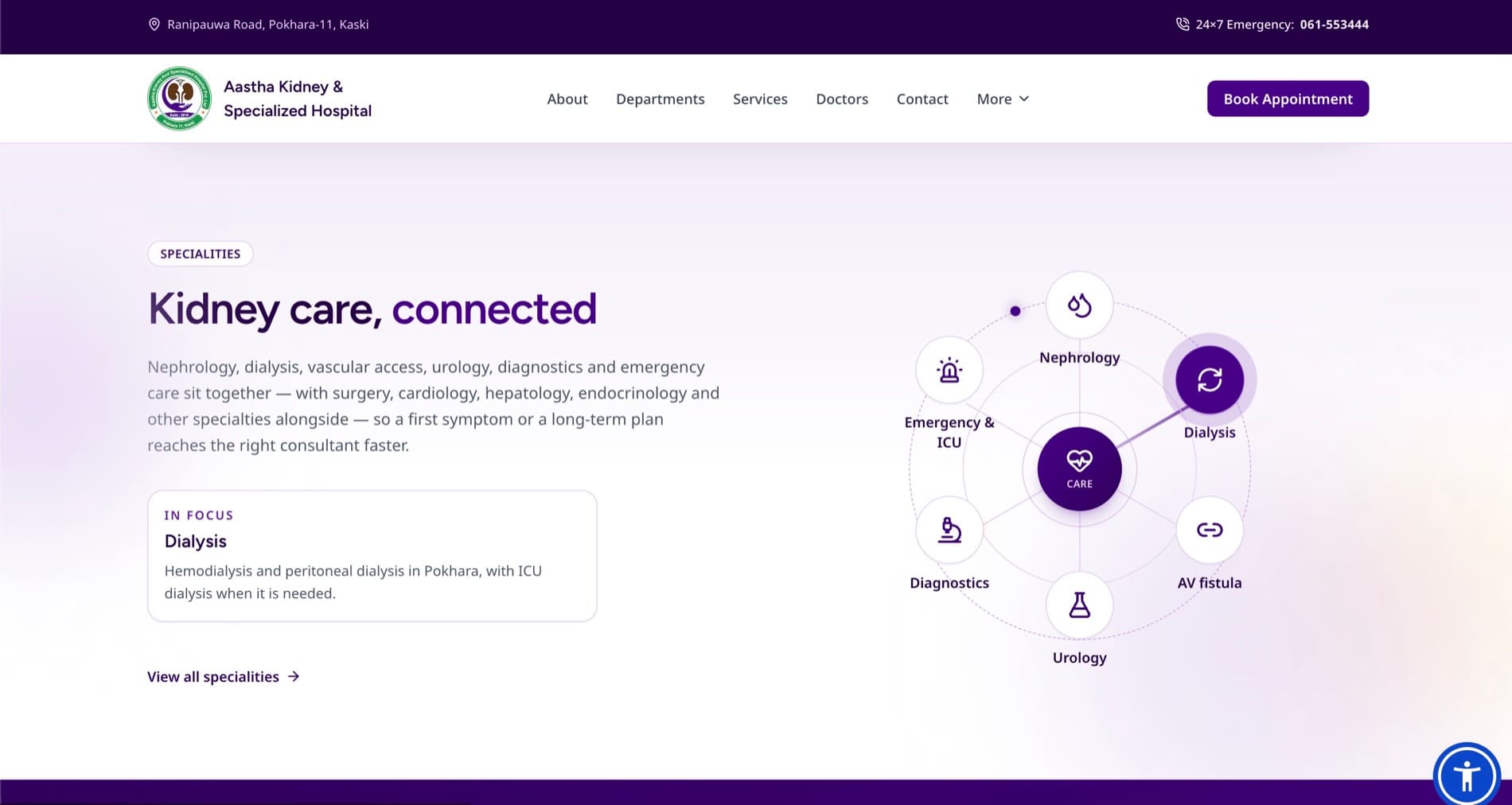
A modern, credible public website for a specialist kidney hospital — doctor and department directory, services, and an online appointment-request flow — wired to the management system through a small, stable API so the site always reflects live hospital data rather than a static copy.
A reactive internal system built on React, TanStack Start, and a self-hosted Convex backend, covering patient registration and profiles, visit history and clinical notes, internal appointment scheduling, and ward & bed management across General Ward, ICU, and Post-Operative units — built to stay fast on the low-spec hardware reception actually uses so a walk-in can be registered in seconds.
A follow-up engine built around the recurring dialysis schedules that define renal care, with a configurable, colour-coded urgency status and an automated SMS pipeline — provider-agnostic gateway, message queue, scheduler, delivery logs, and duplicate prevention — so reminders reliably reach patients and doctors on time.
A reporting suite covering new patients, appointments and no-shows, appointment-request conversion, follow-up completion and overdue counts, and SMS delivery — with date ranges expressed in the Nepali Bikram Sambat calendar hospital staff actually use, so the numbers are readable without mental conversion.
Role-based access seeded for hospital staff — administration, doctors, reception, nursing and more — and enforced server-side on every backend function rather than merely hidden in the UI, with full audit and activity logging and configurable system settings.
Hospital records managed
Automated
Dialysis follow-up reminders
Technology used