Performance Marketing
Industry: Financial Services

821,428
Meta ad impressions, 56 campaigns
In short
Arcetis ran an approximately 8-month paid social and organic content program (November 2025 to June 2026) for a 6-location used-car and auto-loan financing business that serves credit-challenged consumers, building out Meta Ads lead-generation campaigns, a landing-page-view campaign, boosted posts, and Instagram direct-message campaigns alongside an organic Instagram/TikTok content operation. Across the paid Meta program, a lead-generation conversion campaign produced 32 leads at $63.21 per lead and a separate lead-generation form campaign produced 19 leads at $10.21 per lead, while a landing-page-view campaign drove roughly 811-817 page views at $0.62 per view, all on total Meta ad spend of $2,762.90 across 102,097 impressions and 171,472 total views. By the program's June reporting period, the organic channel had grown to 5,987 Instagram followers and 291,000+ combined Instagram and TikTok video views.
The client is a used-car and auto-loan financing business operating six physical locations, serving credit-challenged consumers — buyers who do not qualify for financing through conventional lenders — since approximately 2012. Despite over a decade in the market, the business needed a structured digital acquisition channel to generate finance-application leads and build brand presence for its locations, rather than relying solely on foot traffic and word of mouth. Arcetis was engaged for approximately 8 months, from November 2025 through June 2026, to build and manage a paid Meta Ads program alongside an organic content presence on Instagram and TikTok. The scope covered lead-generation form campaigns, a landing-page-view campaign, boosted post promotion, and Instagram direct-message campaigns on the paid side, paired with ongoing organic content production designed to build trust and visibility with a demographic often underserved by mainstream auto-finance marketing.
Subprime and credit-challenged auto financing is a segment of the auto industry where trust and clarity matter more than in conventional car buying. The client's customer base — people who have been declined by banks or traditional lenders — is often wary of financing offers that sound too good to be true, and a used-car and auto-loan financing business built around this audience needs marketing that reads as credible and local rather than generic. With six physical locations, the business also faced the operational complexity of any multi-location retailer: attention, budget, and lead flow need to be distributed across locations rather than concentrated on a single storefront, and any paid advertising program has to be structured so leads can eventually be tied back to a specific location and sales team rather than disappearing into an undifferentiated pool. Having operated since approximately 2012, the business had an established physical presence but, prior to this engagement, had not run a structured paid social program or a consistent organic content operation across the platforms most likely to reach the demographic that composes its customer base. Instagram and TikTok are both platforms where younger and credit-building consumers spend time, but neither platform's organic reach happens by default — building followers, video views, and a real audience requires consistent posting volume and a native, platform-appropriate content style rather than reused dealership marketing assets. On the paid side, generating finance leads through Meta requires more than a single campaign type: form-based lead ads capture contact information quickly but can carry a higher cost per lead, while landing-page-view campaigns are cheaper per interaction but require a destination page built to convert or nurture views into contact. Boosted posts and Instagram messaging add lower-friction paths for prospects not yet ready to fill out a form. The challenge, in short, was building out and running all of these campaign types in parallel for a financial-services business, in a way that produced trackable, attributable lead volume without the business having a pre-existing paid media or content infrastructure to build on.
Arcetis led the build-out and ongoing management of the client's Meta Ads account across the full engagement window. Arcetis built and ran a lead-generation conversion campaign and a separate lead-generation form campaign, each using Meta's native lead-form ad units to capture contact information directly on-platform. Arcetis built and managed a landing-page-view campaign to drive lower-cost, top-of-funnel traffic to the client's website. Arcetis set up and ran boosted post promotion to extend the reach of organic content with paid budget, and managed Instagram direct-message campaigns as a lower-friction contact path for prospects. Alongside the paid program, Arcetis produced and published organic content across Instagram and TikTok on an ongoing basis, growing the account's post volume and follower base over the engagement. Arcetis also tracked and reported on performance monthly, including a June reporting period covering both paid and organic results, and monitored cost-per-lead and cost-per-view across each campaign type.
Arcetis built and managed two distinct Meta lead-generation programs for the client: a lead-generation conversion campaign and a separate lead-generation form campaign, each using Meta's native on-platform lead forms so prospects could submit contact information without leaving Instagram or Facebook. The two campaigns were run and tracked independently, which allowed cost-per-lead to be compared directly between structures — the conversion campaign produced 32 leads at $63.21 per lead, while the separate lead-generation form campaign produced 19 leads at $10.21 per lead. Running both in parallel gave the client two working lead channels rather than a single, unverified approach.
Arcetis built and ran a landing-page-view campaign designed to drive lower-cost traffic to the client's website as a top-of-funnel complement to the on-platform lead forms. The campaign drove approximately 811-817 page views at a cost of $0.62 per view, giving the client a much lower per-interaction cost than the form-based lead campaigns, at the tradeoff of an extra step between the ad click and a captured lead. This campaign type is typically used to build a retargeting-ready audience and to surface interest from prospects who aren't ready to submit contact information directly through an ad.
Arcetis used Meta's boosted post format to extend the paid reach of the client's organic content, putting budget behind posts that were already performing organically or that featured specific vehicles, financing offers, or location information. Boosting existing content is typically a lower-cost way to add reach and engagement on top of an organic content calendar, without building dedicated ad creative from scratch for every campaign. This gave the client a way to amplify content across its 6 physical locations without treating paid and organic as fully separate workstreams.
Arcetis set up and managed Instagram messaging campaigns, using Meta's ad tools to route prospects directly into an Instagram DM conversation rather than a lead form or landing page. For a financing product where prospects often have questions before submitting personal or financial information, a messaging-based contact path offers a lower-commitment first step than a form, and gives the client's team a direct, two-way channel to answer questions in real time. This ran alongside the lead-form and landing-page campaigns as a third contact path within the same overall Meta Ads program.
Arcetis planned and produced ongoing organic content across Instagram and TikTok for the client's six-location business, publishing a cumulative 1,078 Instagram posts over the course of the engagement. By the June reporting period, the organic content operation had grown the account to 5,987 Instagram followers and had generated 291,000+ combined video views across the two platforms (180.0K on Instagram and 111,594 on TikTok), building an audience and brand presence independent of paid spend.
Cropped directly from the actual account — business-identifying details removed.

Real Meta Ads Manager account totals across the full engagement — total spend, impressions, and cost per 1,000 impressions (business name redacted).
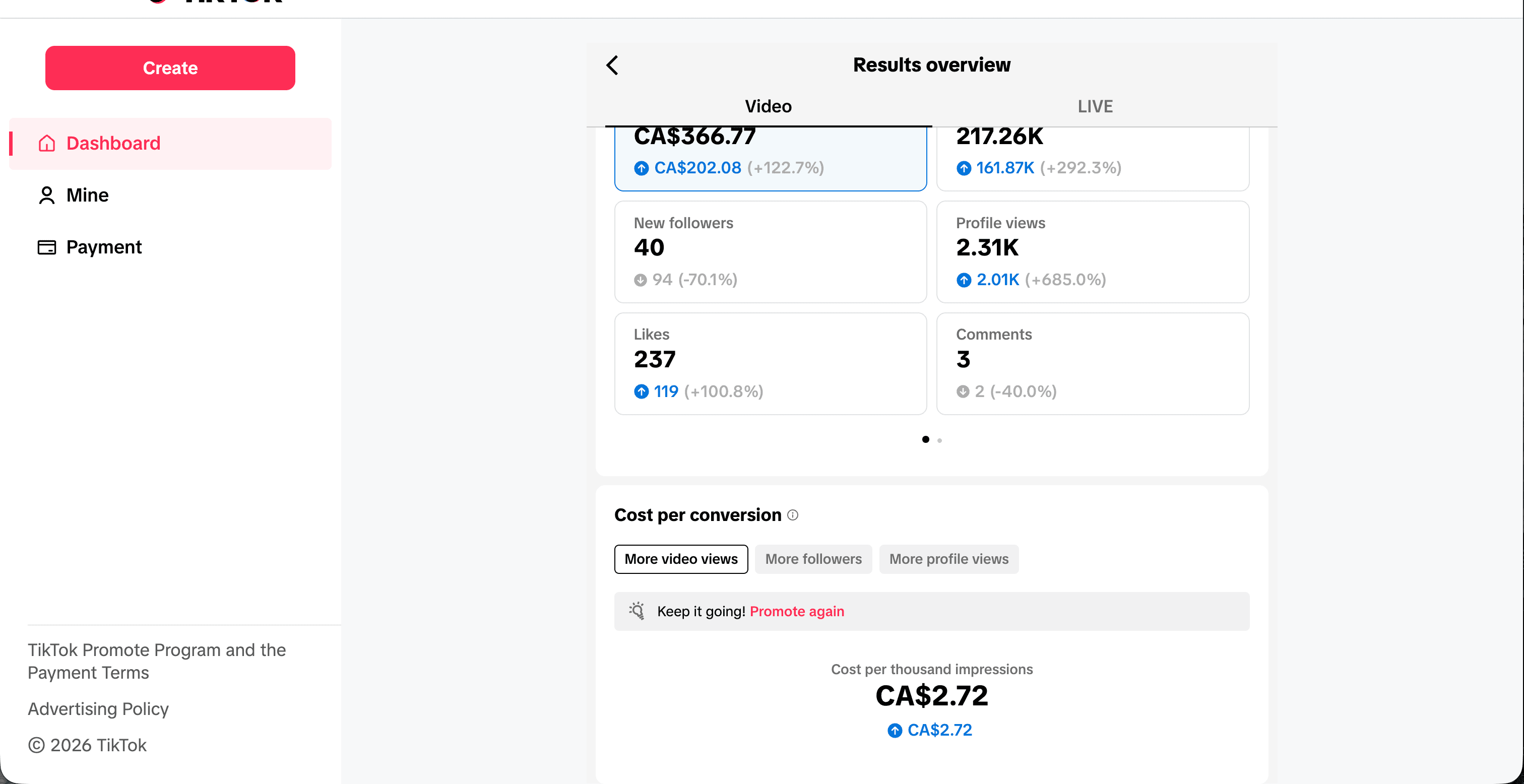
Real TikTok Promote results overview — ad cost, video views, new followers, and profile views for a boosted campaign (account name redacted).
Arcetis structured the Meta Ads account around campaign objective rather than trying to run a single, catch-all campaign. Lead-generation objectives were split into two separate campaigns — a lead-generation conversion campaign and a separate lead-generation form campaign — so that creative, audience, and budget could be tested and optimized against each format independently rather than blended into one average. Each used Meta's native on-platform lead form unit, the standard approach for financial-services lead generation on Meta because it removes the extra step (and drop-off) of sending a click to an external landing page before a prospect can submit their information. Financial products like auto loans generally fall under Meta's Special Ad Category rules for credit, which as a matter of platform policy restrict how narrowly this kind of campaign can be targeted compared with a standard retail campaign — accounts in this vertical typically work within broader audience targeting and straightforward, transparent offer messaging as a matter of Meta's own advertising policy, not a client-specific choice. Separate from the two on-platform lead campaigns, Arcetis built a landing-page-view campaign pointed at the client's website, standard practice for building a lower-cost, top-of-funnel audience and for creating a retargeting pool that can be layered into later campaign phases. Because this campaign optimizes for page views rather than form completions, it was budgeted and reported on separately from the lead-form campaigns so cost-per-view and cost-per-lead were never conflated in performance reviews. Boosted post promotion and Instagram messaging campaigns were layered onto the account as lower-friction, lower-cost complements to the two primary lead-generation formats — a standard structure for a multi-location local business where not every prospect is ready to fill out a form on first contact. Boosting posts let existing organic content carry paid reach without a separate creative production cycle, while Instagram messaging ads routed warmer or more hesitant prospects into a direct conversation with the client's team. On the organic side, Arcetis ran a continuous content production and publishing cadence across Instagram and TikTok, treating the two platforms as related but distinct — content was adapted to each platform's native format and posting cadence rather than cross-posted identically, standard practice for building genuine reach on TikTok specifically, since the platform's distribution favors native-feeling content over repurposed ad creative. Over the engagement this produced a cumulative 1,078 Instagram posts and, combined with paid boosting layered on top of some of that content, contributed to the account's follower and view growth. Performance across every campaign type was tracked and reported on a recurring basis, with a June monthly report consolidating both the paid Meta metrics (spend, impressions, views, leads, and cost-per-lead by campaign) and the organic metrics (posts, followers, and video views by platform), giving the client a single point of reference for how each channel and campaign type was performing rather than separate, disconnected data sources.
Running a lead-generation conversion campaign and a separate lead-generation form campaign side by side, rather than merging them, made it possible to compare cost-per-lead directly between two different Meta campaign structures. The conversion campaign produced 32 leads at $63.21 per lead, while the separate form campaign produced 19 leads at $10.21 per lead — a meaningful difference in efficiency that would not have been visible if the two had been run as a single blended campaign. This kind of structural separation is what makes lead-quality and cost tradeoffs measurable rather than assumed.
The landing-page-view campaign was built and budgeted separately from the lead-form campaigns, driving approximately 811-817 page views at $0.62 per view. Isolating this campaign type kept its very different cost profile from skewing the account's overall cost-per-lead figures, and gave the client a lower-cost channel for building website traffic and a retargeting-ready audience alongside the more expensive, higher-intent form campaigns. This kind of layered structure — cheap top-of-funnel reach paired with higher-cost, higher-intent lead capture — is standard for accounts that need both volume and qualified contacts from one monthly budget.
Arcetis ran organic publishing across Instagram and TikTok as two distinct content operations rather than a single cross-posted feed, reflecting each platform's different distribution mechanics. Over the engagement this produced 1,078 total Instagram posts and, by the June reporting period, 291,000+ combined video views split between Instagram (180.0K) and TikTok (111,594) — evidence that platform-native content, not repurposed dealership ads, was driving the organic reach.
Between the two lead-form campaigns, the landing-page-view campaign, boosted posts, and Instagram messaging, the account covered the full range of Meta ad formats relevant to a local, multi-location financial-services business — from low-commitment awareness and messaging to direct, form-based lead capture — within a total spend of $2,762.90 across 102,097 impressions and 171,472 total views. Structuring the account this way meant prospects at different levels of readiness, from casual scrollers to people ready to submit a loan application, each had an appropriate next step rather than being funneled toward a single conversion action.
Meta ad impressions, 56 campaigns
Total Meta ad spend, full 8-month engagement
Technology used
Key learnings
This engagement demonstrates a straightforward, honest way to run paid social for a regulated, trust-sensitive financial product: rather than assuming one campaign format is "the" answer for lead generation, Arcetis built and ran multiple Meta campaign types in parallel — two different lead-form structures, a landing-page-view campaign, boosted posts, and Instagram messaging — and reported on each separately. That structure is what surfaced a real, useful finding: the two lead-generation campaigns produced very different costs per lead ($63.21 versus $10.21) even though both used Meta's native form format, exactly the kind of comparison that gets lost if campaigns are merged or under-segmented. It also meant the client wasn't reliant on a single channel — the landing-page-view campaign added a much cheaper, if less direct, top-of-funnel path at $0.62 per view. The organic side reinforces the same lesson from a different angle: growing to 5,987 Instagram followers and 291,000+ combined video views took a genuine, ongoing content operation (1,078 posts over the engagement) rather than a handful of boosted posts. For a business serving credit-challenged consumers, where trust matters more than for a typical retail purchase, that kind of consistent, platform-native content presence is arguably as important as the paid lead flow itself. None of the figures here are projections — they are what the account and content actually produced over the roughly 8-month engagement, reported transparently rather than rounded up or blended into a single headline number.
This engagement ran for approximately 8 months, from November 2025 through June 2026, covering both the initial build-out of the Meta Ads account (lead-generation campaigns, a landing-page-view campaign, boosted posts, and Instagram messaging) and an ongoing organic content operation across Instagram and TikTok. Timelines for similar programs depend on how many campaign types and content channels are in scope, but an 8-month window is enough to build out multiple campaign structures, gather meaningful cost-per-lead data on each, and grow an organic content presence from scratch.
For this client, Arcetis delivered a Meta Ads account built around multiple lead-generation formats (on-platform lead forms and a landing-page-view campaign), boosted post promotion, Instagram direct-message campaigns, and an ongoing organic content calendar across Instagram and TikTok. The mix is designed around the reality that credit-challenged consumers considering an auto loan may not be ready to fill out a form on first contact, so the program included lower-friction options — messaging, boosted content, and page views — alongside direct lead capture.
Arcetis tracks cost-per-lead and cost-per-view separately for each campaign type rather than blending results into a single average. In this engagement that meant reporting the lead-generation conversion campaign (32 leads at $63.21 per lead) separately from the lead-generation form campaign (19 leads at $10.21 per lead) and separately again from the landing-page-view campaign (roughly 811-817 views at $0.62 per view), alongside monthly organic metrics like follower growth and video views. Keeping campaign types separate is what makes it possible to see which formats are actually the most cost-efficient.
For this 6-location auto-loan financing business, Meta Ads produced tracked leads in two different campaign formats and low-cost landing page traffic on a modest total spend of $2,762.90 across 102,097 impressions. Results varied meaningfully by campaign type — cost-per-lead ranged from $10.21 to $63.21 depending on the format — which is typical for financial-services advertising on Meta and is why Arcetis runs multiple campaign structures in parallel rather than committing an entire budget to one format.