SEO, Social & Brand
Industry: Food & Beverage
422K
Search impressions (28-day, GSC)
In short
Arcetis ran a roughly seven-month organic growth and brand identity engagement (Dec 2025-Jun 2026) for a multi-location South Asian restaurant group, covering local SEO, organic social across Facebook, Instagram, and TikTok, and a full brand refresh (logo, typography, packaging and signage guidelines). Local SEO drove 422,000 Google Search impressions and 2,010 clicks over a 28-day Search Console window (average position 4.8, 0.5% CTR), with GA4 recording 2,700 active users in the same period; social growth was uneven — a strong December-January period (+33.71% followers, +135.71% posting volume) gave way to a decline through spring before rebounding in June (+95.86% engagement, +116.11% impressions, +127.82% reach month-over-month). No paid advertising was part of the engagement — every figure reported here is organic.
Between December 2025 and June 2026, Arcetis ran a roughly seven-month organic growth and brand engagement for a multi-location South Asian restaurant group. The client needed three connected things at once: a coordinated organic social presence across Facebook, Instagram, and TikTok, a local SEO program capable of driving visibility across all of its locations in Google Search, and a full brand identity refresh — a new logo, typography system, and packaging/signage guidelines — to give the group one consistent look across every location and touchpoint. The engagement did not include paid advertising; all reported search and social results are organic. Arcetis held responsibility for strategy, execution, and reporting across all three workstreams, sequencing the brand identity work early enough that the refreshed assets could be used consistently in both the social content and the SEO-facing side of the business.
A multi-location South Asian restaurant group needed to build a consistent public-facing identity and a repeatable way to reach new customers online, with the engagement scoped to organic channels only rather than paid media. Operating multiple physical locations creates problems a single-location restaurant doesn't face: each location needs to be found independently in local search results, while the group as a whole needs one recognizable brand that customers associate with quality and consistency no matter which location they visit. Before this engagement, the group's organic social presence spanned Facebook, Instagram, and TikTok — three platforms with different content formats, audience behavior, and algorithmic requirements — and needed a coordinated content strategy rather than three disconnected feeds run independently of each other. On the search side, local SEO for a multi-location restaurant group means competing for visibility across many geographic search queries at once, often against food delivery aggregators and directory listings that can outrank an individual restaurant's own website and location pages. And because organic social growth for restaurant brands is seasonal and trend-driven — a strong holiday push or a viral video can spike numbers for a few weeks before performance settles back down — the group needed a partner who would report performance honestly across the full period rather than only around the peak weeks. The brand identity itself also needed direct attention: a logo and typography system with the flexibility to run across a website, social templates, in-store and exterior signage, and takeout/delivery packaging, each with different production constraints — print color accuracy and durability for packaging, legibility at small sizes for social thumbnails, visibility at a distance for signage. Bringing organic social, local SEO, and brand identity together under one engagement meant the work had to be sequenced deliberately: the refreshed brand assets — logo, typography, color, and the packaging/signage guidelines — needed to be ready early enough to be used consistently across the social content and any location-facing SEO work, rather than launching each stream in isolation and retrofitting the others afterward.
Arcetis acted as the client's organic growth and brand partner across a seven-month engagement, holding responsibility for strategy, execution, and reporting on three connected workstreams. Arcetis led day-to-day content strategy and publishing across Facebook, Instagram, and TikTok, adapting a shared content plan to each platform's native format — short-form video for TikTok and Instagram Reels, static and carousel posts for Facebook and the Instagram feed. Arcetis managed the local SEO program for the restaurant group's locations, monitoring visibility and traffic through Google Search Console and GA4. Arcetis designed the brand identity refresh end to end, including a new logo and typography system, and translated that system into practical packaging and signage guidelines the client could hand to print vendors and location managers. Arcetis was also responsible for pulling and reporting performance data across both the SEO and social workstreams throughout the engagement.
Arcetis built and managed a local SEO program covering the restaurant group's multiple locations, aimed at improving organic visibility in Google Search for location-specific and cuisine-specific queries. Work was tracked through Google Search Console and GA4, with reporting on clicks, impressions, click-through rate, and average search position. Over a 28-day Search Console window, the program produced 422,000 impressions and 2,010 clicks at a 0.5% click-through rate and an average position of 4.8, while GA4 recorded 2,700 active users over the same period.
Arcetis ran organic content strategy, creation, and publishing across Facebook, Instagram, and TikTok for the restaurant group. Growth was not linear over the seven months: a strong December-January push grew followers 33.71% to 13.94K and posting volume 135.71% to 33 posts, before performance declined through February to May. Activity rebounded in June, with month-over-month engagement up 95.86%, impressions up 116.11%, and reach up 127.82%. No paid social spend was part of this engagement — all social growth reported here is organic.
Arcetis led a full brand identity refresh for the restaurant group, including a new logo and a supporting typography system designed to work consistently across digital and physical touchpoints. The refresh was built to give the group one cohesive visual identity across all its locations rather than location-by-location variation, and to give the marketing and social workstreams consistent assets — logo lockups, type, and color — to build content and location pages around from the same source.
Beyond the core brand identity, Arcetis produced packaging and signage guidelines translating the new logo and typography system into practical specifications for takeout/delivery packaging and in-store and exterior signage. These guidelines gave the restaurant group's operations team and print vendors a single reference for applying the refreshed identity consistently across physical materials at every location, rather than leaving color, logo placement, and typography open to interpretation location by location.
Arcetis reported on performance across the SEO and social workstreams throughout the engagement, using Google Search Console and GA4 for search and site traffic and native platform analytics for Facebook, Instagram, and TikTok. Reporting was structured around defined windows — a 28-day Search Console/GA4 period for search metrics, month-over-month comparisons for social — so the client could see real trend direction, including the social decline between the December-January peak and the June rebound, rather than a single cherry-picked snapshot.
Cropped directly from the actual account — business-identifying details removed.
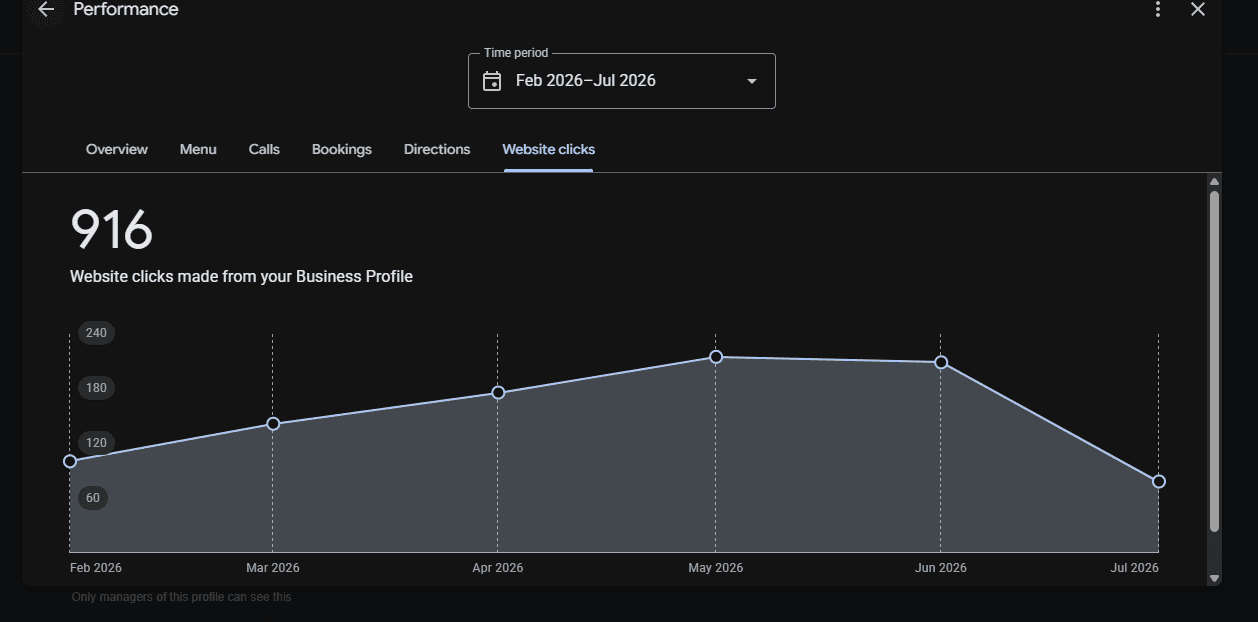
Real Google Business Profile performance — website clicks generated directly from the business's local profile over a 6-month window (business name redacted).
The engagement ran approximately seven months, from December 2025 through June 2026, structured as three workstreams — organic social, local SEO, and brand identity — coordinated together rather than run as independent projects. For local SEO, Arcetis worked from the standard structure used for multi-location restaurant clients: keeping business information accurate and consistent for each location wherever it appears online, building out location-relevant content and metadata so search engines can match each location to nearby search queries, and monitoring the technical health of the site so pages remain crawlable and indexable. Performance was tracked directly in Google Search Console (impressions, clicks, click-through rate, and average position) and cross-referenced against GA4 for on-site behavior, with the team reviewing rolling 28-day windows to catch trend shifts early rather than waiting for quarter-end reporting. For organic social, Arcetis built a content calendar spanning Facebook, Instagram, and TikTok that accounted for each platform's different content requirements — short-form vertical video for TikTok and Instagram Reels, and a mix of static posts, carousels, and Stories for Facebook and the Instagram feed — rather than publishing identical content across all three. Restaurant social content of this kind typically leans on food and location-specific imagery and video, and posting cadence increased significantly during the December-January period, reflected in the 135.71% jump in post volume alongside follower growth in that window. When performance declined in the months that followed, the team continued tracking and reporting the numbers as they actually were rather than adjusting the reporting window to obscure the dip, and used the June rebound to review what had changed in posting mix and cadence relative to the slower months. For the brand identity refresh, Arcetis followed a standard identity design sequence: understanding the existing brand and locations, developing logo concepts and a typography system, and then stress-testing that system against the physical and digital contexts it would actually need to work in — social profile images and thumbnails, a website, in-store and exterior signage, and takeout/delivery packaging. Because packaging and signage carry real production constraints (print color accuracy, legibility at a distance, durability outdoors) that a purely digital brand refresh doesn't need to account for, the guidelines documentation was scoped specifically to give the client's operations team and outside print vendors clear, unambiguous specs rather than leaving those decisions to be reinterpreted location by location. Because all three workstreams shared the same underlying identity, sequencing mattered: the refreshed logo, typography, and color system needed to be finalized early enough that both the social content templates and any SEO-facing location pages could use the same assets, avoiding a situation where social or search-facing work had to be redone once the new brand landed. Reporting throughout the engagement was kept in the same format the client would see going forward — Search Console and GA4 for search and site traffic, native analytics for each social platform — so results could be reviewed consistently period over period rather than reconstructed after the fact.
The local SEO program was built around the reality that a multi-location restaurant group needs individual location visibility as well as one consistent brand, rather than being treated as a single generic entity. Search Console data was reviewed to identify which queries and pages drove impressions and clicks, and a consistent 28-day reporting window was used so month-to-month or seasonal shifts in search behavior could be read accurately rather than compared against mismatched date ranges.
Rather than relying on Search Console alone, Arcetis paired it with GA4 to see what happened after a searcher clicked through. The 2,700 active users recorded in GA4 over the same 28-day window as the 2,010 Search Console clicks gave a fuller picture of on-site engagement, helping distinguish search visibility (impressions and position) from actual on-site activity.
Facebook, Instagram, and TikTok reward different content formats and posting behavior, so the social workstream was not run as one piece of content copy-pasted across three platforms. Short-form video was prioritized for TikTok and Reels, while Facebook and the Instagram feed carried more static and carousel formats — an adaptation reflected in metrics that moved independently by channel and by month rather than in lockstep.
The typography and logo system produced in the brand refresh was tested against physical production requirements, not just on-screen use — packaging substrates, print color reproduction, and signage visibility at a distance all impose constraints a screen-only identity doesn't face. The resulting packaging and signage guidelines document specifies how the identity should be applied consistently across those physical formats.
Organic social performance across the seven months was not a straight upward line — a strong December-January period was followed by a decline through February-May before a June rebound. Arcetis reported each period's actual numbers, including the decline, rather than presenting only the December-January peak or the June rebound in isolation, which is the more common — and less accurate — way this kind of data typically gets presented.
Search impressions (28-day, GSC)
Active users (28-day, GA4)
Technology used
Key learnings
This engagement is a useful example of what an honest, multi-channel organic engagement looks like when the results are mixed rather than uniformly positive. The local SEO and GA4 numbers — 422,000 impressions, 2,010 clicks, and 2,700 active users over a 28-day window — show a solid volume of organic search visibility for a multi-location restaurant group competing against delivery aggregators and directory listings. The social data tells a more complicated story: a strong December-January period followed by a real decline through February-May, then a June rebound. Reporting that full arc, rather than only the December-January peak or only the June rebound, is what makes the data trustworthy — a restaurant group evaluating this kind of engagement should expect organic social performance to move in cycles tied to content cadence, seasonality, and platform algorithm shifts, not in a straight line. The engagement also demonstrates why brand identity, SEO, and social shouldn't be scoped as three separate, disconnected projects for a multi-location client: the logo, typography, packaging, and signage work fed directly into what could be used consistently in social content and on location-facing pages, and sequencing the brand work early enough to support the other two workstreams avoided rework later. The absence of paid media in this engagement also means every number reported here — search or social — reflects organic performance only, a meaningfully different and generally slower-building growth path than a paid-inclusive engagement would show.
This engagement ran approximately seven months, from December 2025 through June 2026, covering organic social, local SEO, and a full brand identity refresh as three coordinated workstreams rather than sequential, separate projects.
For this restaurant group, Arcetis delivered a local SEO program spanning all locations, organic content strategy and publishing on Facebook, Instagram, and TikTok, and a brand identity refresh including a new logo, typography system, and packaging/signage guidelines for print vendors and location teams to apply consistently.
No. In this engagement, a strong December-January period (followers up 33.71% to 13.94K, posting volume up 135.71% to 33 posts) was followed by a decline through February-May, then a rebound in June (engagement up 95.86%, impressions up 116.11%, reach up 127.82% month-over-month). Organic social performance for restaurant brands typically moves in cycles tied to content cadence and seasonality rather than a straight upward trend, and honest reporting reflects that instead of only showing peak periods.
No. This engagement covered organic social and local SEO only, with no paid ad spend or paid-ads reporting in scope, so every metric reported — search impressions and clicks, GA4 active users, and social growth — reflects organic performance.